Sign up to
Fill in the Google Form to
- Sign up for updates,
- share your notes for a emerging map of the regenerative economy,
- and be part of the community.
Why contribute?
We're gathering insights from across the streams of work at the Victoria Forum to map out the projects and initiatives happening in Canada that could drive systemic transformation.
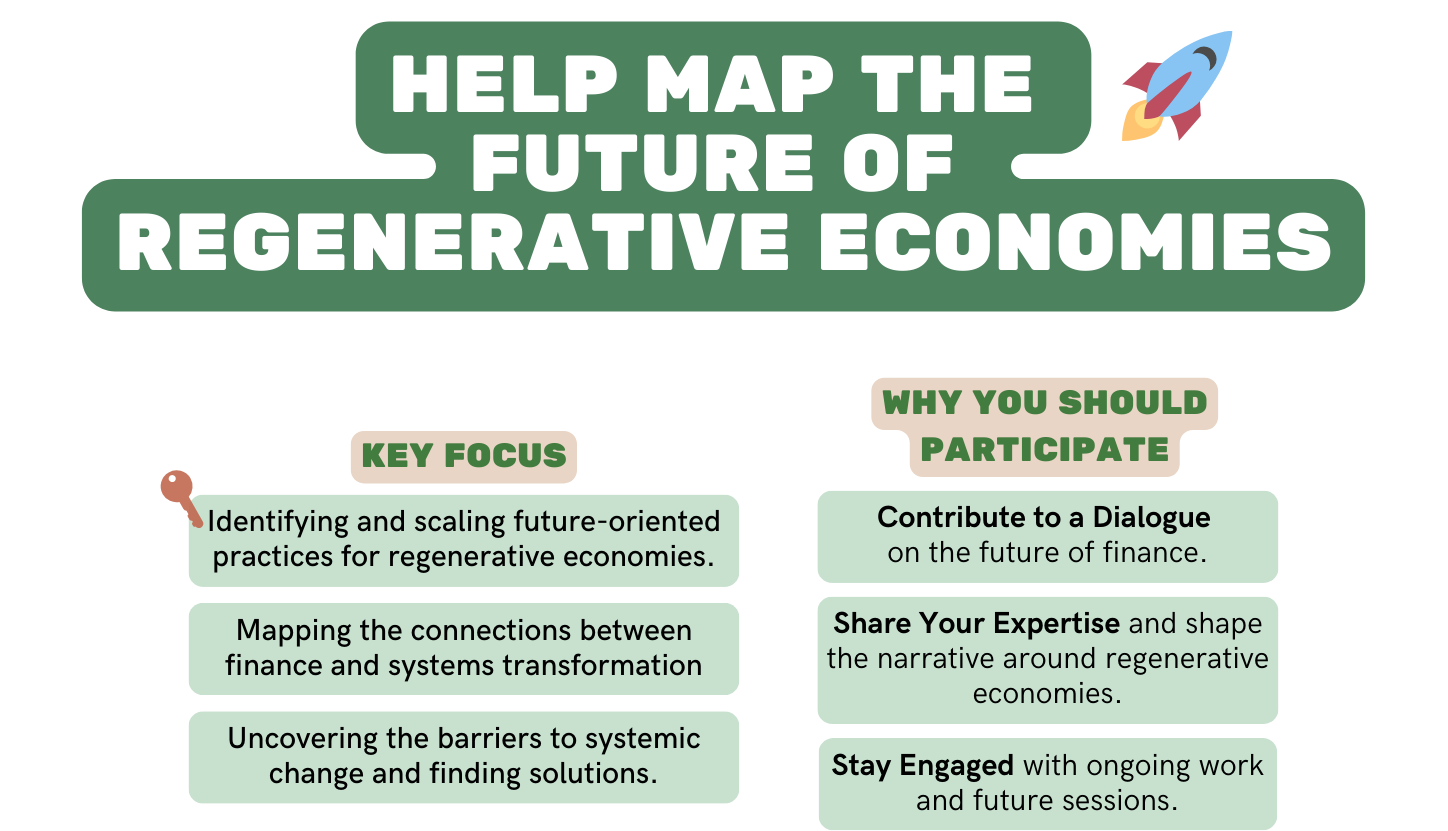
This initiative seeks to understand and map the current landscape of regenerative economies and systems transformation, focusing on how funding ecosystems can evolve to support sustainable development and long-term value creation.
Contribute to this project by sharing your notes from the Victoria Forum here.
We are conducting this exercise because the transition to a regenerative economy requires systemic change across financial institutions, governance structures, and community engagement. The mapping process will help the community engage the new economy to "see," connect, and cohere the emerging funding ecosystem that can accelerate the transformational agenda required by a regenerative economy. By identifying leverage points, barriers, and opportunities, we aim to support participants to accelerate this transition.
Who We Are
We are an emerging community of practice and learning circle with members of The Waterloo Institute for Complexity and Innovation, The Victoria Forum, Solvable, FEST, and others.
Let us know in the form if you would like to be part of the community.
Key Definitions
- Mapping: A systematic process of identifying and visualizing the interconnections within and between different domains, actors, and practices in the funding ecosystem.
- Domains: Sectors or areas within the economy or society where regenerative practices are emerging.
- Funding Ecosystems: The complex networks of financial institutions, investors, rights-holders, and stakeholders involved in the allocation, flow, and transformation of capital and access, particularly in support of regenerative and transformative practices.
Approach
We are using the Victoria Forum as a launchpad to gather insights, stories, and practices related to regenerative finance and systems transformation. The insights gathered at VF will serve as the foundation for a mapping process, focused on understanding the funding ecosystem necessary for the systemic transformation towards a regenerative economy. The process will involve ongoing contributions from participants and the wider community.
Why You Should Be Part of the Exercise
Your involvement in this mapping exercise is crucial because you are part of a community at the forefront of exploring or implementing approaches to drive systemic change, either as a participant or observer.
By contributing, you can help shape the narrative and identify the key leverage points within the funding ecosystem. Your insights will contribute to a collective effort to visualize and address the barriers to systemic finance approaches.
Google Form
The form invites you to share projects, opportunities, or ideas that should be on the map, whether you are a part of them, or hear about them from others.
It also includes opportunities to share your interest in ongoing involvement in the community and/or in the mapping process.
What Will Happen After Victoria Forum?
After the Victoria Forum, we will facilitate sense making and co-creation sessions to work with the material to begin to build a picture of what is emerging in Canada, as well as sessions to share back the reuse of the process.
This work will also continue with a mapping effort building with and inspiring by the FEST network's work and the Clouds and The Forests Story, towards a map like the CoFundEco map.
The results of the process will be shared in future sessions, reports, and potentially through a publicly accessible platform, and will be a resource the community can come together to analyze, make sense of, and build from.
How You Can Get Involved
Contribute to the Mapping Process: Share Your Insights
- What: Submit your ideas, experiences, and perspectives through a simple Google Form.
- Why: Your contributions will directly influence the mapping of the regenerative finance landscape and help identify key leverage points for systemic change.
- How: Share projects and ideas in the Google Form.
Join the Listening Cohort/Sharing Circle: Be Part of the Conversation
- What: Participate in discussions and sharing circles to refine and deepen the insights gathered.
- Why: Engage with like-minded individuals, co-create understanding, and shape the direction of the mapping exercise.
- How: Sign-up to find our about sharing circle gatherings in the Google Form.
Attend Feedback Sessions: Engage in Collective Reflection
- What: Engage in feedback sessions where the results of the mapping exercise will be shared and discussed.
- Why: Your input will help refine the mapping process and ensure it reflects the collective vision of all participants.
- How: Sign-up to get updates about the project in the same Google Form or subscribe to updates on this page.
Questions to Hold
These are questions that will guide the discussions and contributions during the Victoria Forum and beyond:
- Financial Approaches and Scaling: Which practices are currently emerging, and what strategies are needed to scale them for systemic impact?
- Barriers and Visualization: What are the barriers to systemic finance approaches, and how can we visualize and address them effectively?
- Ecosystem Support for Innovation: How does the current funding ecosystem support or hinder innovation in regenerative finance, and where do the transformational opportunities lie that can be leveraged for systemic change?
- Mapping Interconnections: How can we map financial institutions' connections to local communities to identify gaps and opportunities to better align capital flows with community needs?
- Value Creation and Visualization: What are the key drivers of value creation across different domains, and how can these be visualized to inform cross-sectoral decision-making?
- Governance Structures: What governance designs and frameworks enable the development of a financing ecosystem that balances public and private interests while facilitating systemic transformation towards a regenerative economy, and how can these structures be strengthened, expanded, or replicated?
- Stewardship and Measurement: How could financial institutions act as stewards of long-term value, and how can their impact be measured and visualized?
- Leverage Points: Where are the critical leverage points within current and emerging funding ecosystems that could unlock significant positive changes with strategic interventions?
- Systems actors in Systemic Transformation: Which system actors are most influential in driving systemic transformation, and how are they connected?
Our hope is that these questions will elicit deep, forward-looking responses that will inform the ongoing mapping exercise and contribute to the transformation of financial systems towards a more regenerative and sustainable model.